
Private strategic counsel for lawyers
Your next client will look you up before they call. What will they find?
In-house lawyers say articles and speeches by thought leaders are among the most important ways they vet outside counsel. Consumers check a lawyer online even after a friend recommends one. Yet most accomplished lawyers have no deliberate system for becoming a trusted voice on the issues their clients follow. I teach lawyers how to build that voice, use it ethically and turn it into client relationships.
A note from one lawyer to another
Adonis Hoffman, Esq.
The Advisory Counsel LLC
100+ media appearances and expert interviews. 150+ published articles and comments.
Not by accident. By design. The methods can be taught.
71%
of in-house counsel call thought leaders' articles and speeches a critical factor in vetting firms
74%
of legal consumers research a firm online even after a personal recommendation
90 days
to a working media profile, built around the clients you want
1-to-1
private instruction, from one lawyer to another, never a classroom
Counsel-to-Counsel is a specialized professional advisory service of The Advisory Counsel, LLC. It is one of two services designed for accomplished professionals seeking greater influence and opportunity. View all professional advisory services →
What this is
The private media-authority advisory for lawyers.
This is not a lesson in publicity. It is a practical education in how lawyers become known, why the media come to trust them, and how public credibility can strengthen a legal practice.
The program is built around three questions every lawyer with a public voice must be able to answer: What do I want to be known for? Who needs to know it? And how do I say it in a way that is both credible and ethically sound?
The purpose of this program is to teach lawyers repeatable professional skills and sound judgment about building a public voice. It does not guarantee articles, interviews, media bookings, or new client engagements. Results depend on the individual lawyer's effort, practice area, and circumstances.
01
How lawyers become known
Owning a field of authority that editors cover and clients follow, and showing up in it consistently with bylines, quotes and commentary.
02
Why the media come to trust them
Being useful on deadline: accurate, quotable, clear about what a development means, and careful about what a lawyer may and may not say.
03
How credibility strengthens a practice
Putting verified clips and published judgment to work with the clients and referral sources who decide whom to hire.
Method
The Media-to-Mandate method
Learn the craft. Build the profile. Reach the client. Tap each step.
Stage 1 · Define the client first
Identify the clients you want, the problems they face and the subjects that connect their concerns to your knowledge. Everything else is built backward from them.
Evidence
Four case files, two lessons
The first two show how clients vet lawyers. The last two show why public commentary takes judgment. Sources are listed at the bottom of the page.
Case 1 · Greentarget/Zeughauser survey, 2022
The corporate buyer
In-house counsel and C-suite decision-makers · Survey published 2022
When corporate legal departments decide which outside lawyers to trust, recommendations still come first. What comes next is what a lawyer has written and said in public.
A referral gets your name onto the list. Your published judgment decides whether you stay on it.
Case 2 · Scorpion Law Firm Search Trends, 2025
The individual client
A survey of 3,000 legal consumers · Report published Oct. 2025
Referrals still start most legal relationships. But the referral is no longer the end of the process. It's the beginning of a search.
The recommendation opens the door. What a prospective client finds when they search your name decides whether they walk through it.
Case 3 · U.S. Supreme Court, 1991
Gentile v. State Bar of Nevada
A defense lawyer's press conference · Decided June 27, 1991
The day after his client, Grady Sanders, was indicted, Las Vegas defense lawyer Dominic Gentile held a press conference. The Nevada bar said his statements violated the state's trial-publicity rule.
Lawyers have a voice, and the rules limit it. Speaking about pending matters is a professional skill governed by trial-publicity rules, not just a question of free speech.
Case 4 · Indiana Supreme Court, 2024
The online review reply
A lawyer who answered a one-star Google review · Discipline ordered July 18, 2024
A former client left a one-star Google review complaining about communication. The lawyer demanded it be removed, and when the client refused, he responded in public.
Visibility without judgment is a liability. Every public word a lawyer writes is still governed by the duty of confidentiality.
The common thread
The common thread
Clients look you up. Rules govern what you say. Both are true at once.
| Case | Shows | Means |
|---|---|---|
| In-house counsel survey | Corporate buyers vet lawyers by what they publish | Your bylines and speeches are part of your pitch |
| Consumer search survey | Referred clients still search before they call | Your public profile must confirm the referral |
| Gentile v. State Bar of Nevada | Lawyers' public statements can be disciplined | Media skill includes knowing the trial-publicity rules |
| Indiana review reply | Confidentiality applies online, even in self-defense | A public voice needs a professional filter |
"You do not need to become a celebrity lawyer. You need to become the lawyer worth calling when your issue makes news."
Self-assessment
You know the law. But do the right people know you?
Tick every statement that's true for you today. Nothing you select leaves this page.
A different offering
A different professional offering
This is not a PR service. It is a practitioner teaching another practitioner how to earn authority through relevance, judgment, and repeatable editorial skill.
Publicity
Hiring someone to get you clips
- ✕A publicist pitches stories on your behalf, and the relationships stay with them
- ✕A media trainer prepares you for one interview, not a career
- ✕A marketer advertises your practice, which clients discount
- ✕When the engagement ends, the skill leaves with the vendor
- ✕Coverage arrives with no plan to turn it into clients
Counsel-to-Counsel
Learning the craft from a practitioner
- ✓You learn to spot the news window and frame an argument yourself
- ✓You build working relationships with reporters directly
- ✓You develop a point of view that editors want to publish
- ✓You keep the judgment and habits for the rest of your career
- ✓Every credible appearance is put to work in your client development
Myth or fact
Six things lawyers believe that the evidence contradicts.
Tap each card to see the fact.
The cost
The cost of staying invisible
Measured against a single client relationship.
The Authority Blueprint · one flat fee
$9,500
A 90-day, hands-on program: your client and media map, three editorial angles, op-ed and pitch sessions, interview rehearsal and a 90-day execution docket.
What invisibility costs
- —The corporate clients who vetted you by what you've published, and found nothing
- —The referred clients who searched your name and kept looking
- —The reporter's call that went to the lawyer down the street
None of it shows up on an invoice. It shows up in the clients who never call.
Engagement II · Strategy · Foundational engagement
The Authority Blueprint
A hands-on program in which I teach you how to earn media attention and translate it into authority in your chosen client market. It's not a booking service and not a publicist on retainer. It's a practitioner teaching another practitioner how to earn attention through relevance, authority and repeatable editorial judgment, and how to use that attention in client development.
What the Blueprint is
A private, one-to-one program built around your practice and the clients you want. We begin with the client and work backward to the issues, publications and audiences most likely to matter to that client. You'll come out with a working media profile, real drafts and the habits to keep it going. You'll understand not just what to do, but why it works and how to repeat it.
Six deliverables
How the 90 days unfold
Weeks 1 to 2 · Client and territory
A private diagnostic session, then your target-client and media territory map. Your Media Docket below is the starting agenda.
Weeks 3 to 5 · Editorial angles
Three timely angles developed into pitches, short commentaries and op-ed theses.
Weeks 6 to 9 · Drafting and pitching
Working sessions on real pitch letters and an op-ed draft, with line-by-line critique.
Weeks 10 to 12 · Rehearsal and docket
Interview rehearsal, the 90-day execution docket and your ethics plan for business development.
At a glance
Why it costs what it costs
From one lawyer to another. I know the judgment clients look for in a lawyer and the clarity the media expect from a source, because I've worked on both sides.
Work you can use. A private media dossier with real drafts, not a generic playbook.
The skill stays with you. You learn to recognize opportunities and make arguments yourself, for the rest of your career.
Ethics built in. Every step is designed around the advertising, confidentiality and trial-publicity rules that govern lawyers.
Aimed at clients, not clips. The objective is not a viral moment. It's a durable, credible public profile aligned with the practice you want to build.
The record
The record I teach from
Every engagement draws on the same work: finding the news window, making the argument, and holding up on air. A cross-section, from Fox Business to CNBC, The Hill to The New York Times.
Hoffman's Wall Street Journal op-ed on the Telephone Consumer Protection Act was cited in a brief before the U.S. Supreme Court in Campbell-Ewald Co. v. Gomez. That is what published judgment can do. Read the op-ed →
Published
- The HillData Centers Have the Tech, Now They Need to Develop Trust
- The HillBeware Beijing Bearing Gifts as Xi Visits White House
- The HillWill 2026 Finally Bring Big Changes to Big Tech?
- The HillDe-Banking Innocent Americans Should Be Illegal
- Fox NewsBlaming Banks for the Environment Is Not Good for Business
- Fox NewsThe TikTok Challenge Is Not What You Think
- Fox NewsBig Tech Must Self-Regulate to Protect Public Safety
- Fox BusinessBig Tech's Battle for Billions Leaves Collateral Damage
- Fox BusinessChinese Companies in America: All Take and No Give
- Fox BusinessCan Big Tech Be Reined In by Rules It Consistently Breaks?
- NYTBroadcasters and Consumers Should Be Wary
On air
- Fox BusinessData Center Developers Need to Develop Trust
- Fox BusinessChina, AI and Data Centers in the U.S.
- Fox BusinessU.S. Developers Need to Stay Competitive
- CNNCongress and TikTok
- CNNNational Security, Social Media and TikTok
- CNBCPros of Regulating Facebook Outweigh the Cons
- CNBCThe Right Time for a T-Mobile Deal for Sprint
- CNBCAT&T–Time Warner: A Unique Antitrust Circumstance
- CNBCIs the AT&T–Time Warner Merger in Jeopardy?
- CNBCAT&T–Time Warner: A Savvy Move by AT&T
- CGTNOn the EU's Policy for Regulating Facial Recognition
Experience, not theory
Adonis Hoffman, Esq.
Attorney. Corporate Advisor and Director. Independent Publisher. Educator and Media Voice.
- Education: Princeton University, A.B. | Georgetown University Law Center, J.D. | Former Adjunct Professor, Georgetown University
- Member of the Bar of the Supreme Court of the United States; member of the District of Columbia Bar for 38 years
- External counsel to Fortune corporations, investment firms, and national trade associations
- Former Senior Legal Advisor, Federal Communications Commission; Former Counsel & Staff Director, U.S. House of Representatives Committee on Foreign Affairs
- 100+ media appearances and expert interviews, including CNN, CNBC, Fox Business, Fox News and others; 150+ published articles and comments in The Hill, L.A. Times, The New York Times, The Wall Street Journal and others
- Expert testimonies before Congressional Committees on the Judiciary, Energy and Commerce
"You do not need to become a celebrity lawyer. You need to become the lawyer worth calling when your issue makes news."
— Adonis Hoffman, Esq.
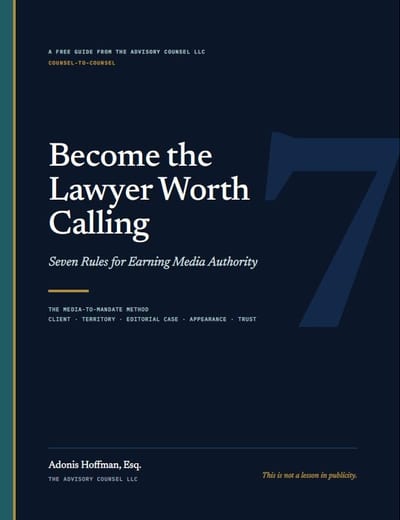
Free Guide · Counsel-to-Counsel
Become the Lawyer Worth Calling
Seven Rules for Earning Media Authority
A practical 12-page guide for lawyers who want to be the voice reporters, producers and clients turn to. Inside:
- How to define the client your media work should reach
- How to find your news territory and make the editorial case
- The twenty-second answer, and how to build one
- The ethics rules that travel with you on air and in print
- A ten-point self-check to see where you stand
Contact
Begin a private discussion.
Tell me what kind of law you practice, the clients you hope to attract and where you want to be heard. I read every inquiry personally and reply within one business day.
What happens next
- 01
You send your inquiry
Your practice, the clients you want and where you hope to be heard.
- 02
A personal reply
Within one business day, to arrange a private discussion at a time that suits you.
- 03
A private discussion
About your goals, your media territory and which engagement fits your practice.
Sources
- 1.LexBlog: 70% of in-house counsel see blogs as a valuable source (Greentarget/Zeughauser 2022)
- 2.Localogy: Scorpion uncovers how consumers find lawyers in 2025
- 3.Wikipedia: Gentile v. State Bar of Nevada, 501 U.S. 1030 (1991)
- 4.Reason / Volokh Conspiracy: Indiana discipline for review responses (July 2024)
- 5.Holland & Knight: ABA clarifies confidentiality obligations for online commentary (Formal Opinion 480)